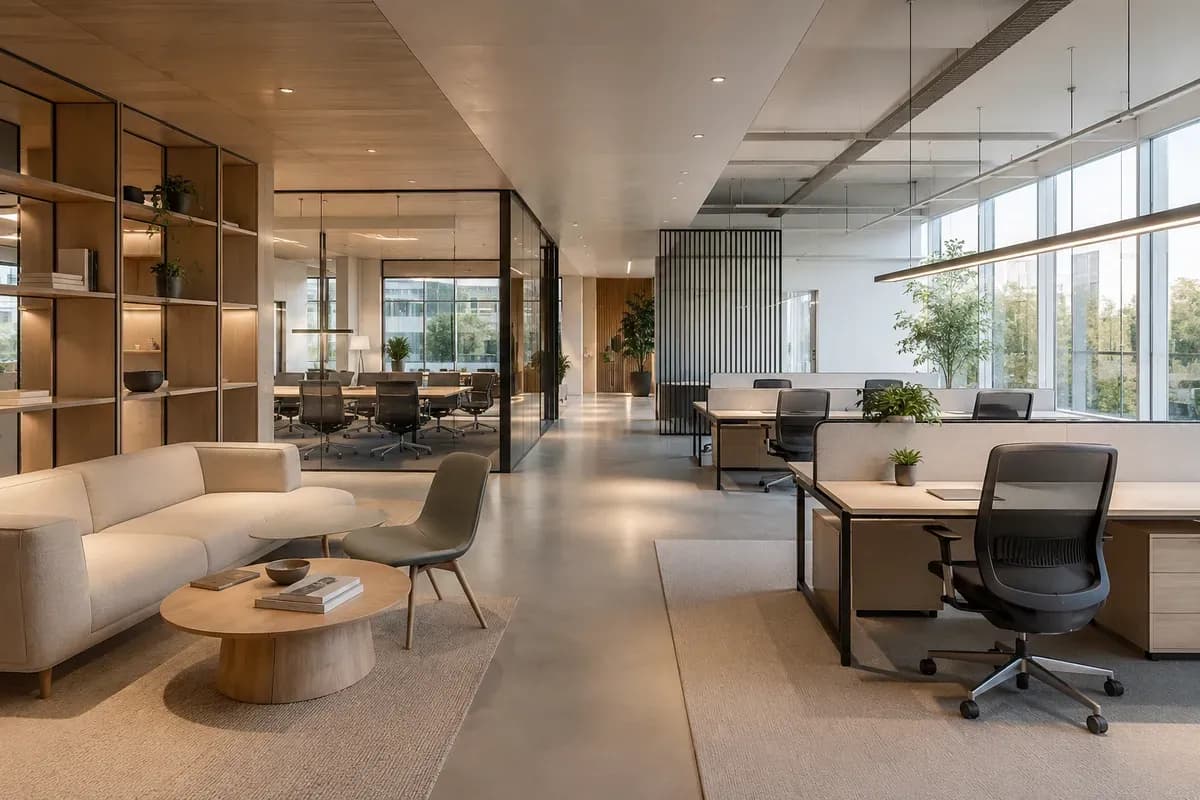
Strategic Office Design: Maximizing Business Impact Through Smarter Workspaces
In today's business environment, an office is no longer just a place to work. It has become a strategic asset that reflects a company's brand image and influences team performance over the long term. More organizations are placing greater emphasis on Workplace Strategy, recognizing that a well-designed office can enhance productivity, improve employee experience, and strengthen credibility with clients and investors.
For organizations occupying approximately 200–300 square meters, strategic space planning ensures that every square meter delivers greater value beyond its basic function.
Challenges in Modern Office Design
While many organizations invest significantly in office interiors, several common challenges often limit the effectiveness of the workspace:
- Spaces are divided into rigid functions with limited flexibility.
- Meeting rooms are often underutilized.
- Common areas fail to support a variety of activities.
- The office design does not reflect the company's brand identity.
As a result, the workplace may struggle to accommodate future growth and fail to create meaningful business impact.
1. Design for Adaptability (Adaptive Workspace)
Modern organizations require spaces that can adapt to different work styles and changing business needs.
Practical Approaches:
- Use partition systems that allow spaces to be reconfigured easily.
- Design meeting areas that can accommodate both small and large gatherings.
- Plan common areas to support multiple functions and activities.
- Incorporate flexible furniture systems that can be moved, reconfigured, or stored efficiently to enable rapid space transformation.
Benefits:
- Supports diverse working styles.
- Increases organizational agility.
- Reduces long-term space limitations.
2. Create a Performance-Driven Layout
Effective office planning should begin with a clear understanding of organizational workflows rather than simply arranging furniture.
Recommended Strategies:
- Utilize open-plan work areas to encourage communication and collaboration.
- Create dedicated zones for different activities, such as:
- Focus Work
- Collaboration
- Meetings
- Minimize low-value areas and allocate more space to activities that directly support productivity.
Benefits:
- Improves operational efficiency.
- Reduces distractions while enhancing focus.
- Better supports teamwork and collaboration.
3. Treat Furniture as a Strategic Workplace Tool
Furniture should be viewed as more than a decorative element. It plays a critical role in shaping the employee experience.
Recommended Strategies:
- Invest in ergonomic furniture that supports long-term comfort and wellbeing.
- Combine modular and flexible furniture solutions to accommodate future changes.
Benefits:
- Enhances comfort and productivity.
- Simplifies future workspace adjustments.
- Creates a higher-quality and more sustainable work environment.
4. Design to Reflect Brand Identity (Brand-Driven Design)
An office is one of the most important brand touchpoints for employees, clients, and business partners.
Key Design Elements:
- Reception area and first impressions.
- Materials and color palettes aligned with brand identity.
- Lighting that enhances atmosphere and user experience.
- Consistent design language throughout the entire workplace.
Benefits:
- Builds trust and credibility.
- Enhances brand perception among clients and partners.
- Transforms the office into an extension of the brand experience.
5. Invest in Long-Term Value
Office investments should be evaluated based on long-term returns rather than upfront costs alone.
1. Elements Employees Use Every Day
These directly impact productivity and wellbeing.
- Ergonomic seating
- Effective lighting systems
- Productivity-focused layouts
2. Spaces That Represent the Brand
These influence credibility and brand perception.
- Reception areas
- Executive meeting rooms
- Client-facing spaces
3. Flexible Spaces That Support Growth
These reduce future renovation costs and accommodate organizational expansion.
- Adaptive layouts
- Flexible furniture systems
4. Infrastructure That Supports Workplace Performance
These systems form the foundation of a high-quality workspace.
- Lighting systems
- Electrical and data infrastructure
- Acoustic solutions
6. A Turnkey Approach to Implementing Workplace Strategy
A turnkey approach is more than simply combining design and construction services. It creates a seamless connection between workplace strategy and real-world execution.
Advantages:
- Space planning is aligned with actual budgets from the beginning.
- Quality and details are managed consistently throughout the project.
- Reduces discrepancies between design intent and construction outcomes.
- Ensures workplace strategy is implemented effectively and efficiently.
For more information, see: Turnkey Office Interior Solutions
Office design today is no longer just about providing functional space. It is about creating a strategic workplace that supports productivity, strengthens brand identity, and enables future growth.
For organizations seeking to elevate their workplace to international standards, early planning and collaboration with a team that understands both design and execution are essential. When approached strategically, office investments can deliver measurable business value and long-term organizational success.